


Standard window units and split systems dominate the residential market, but they have limits. They consume significant electricity and dump heat directly into your immediate surroundings. For large commercial spaces like office buildings, that approach becomes inefficient. The solution often lies in moving the heavy lifting away from individual rooms and into centralized systems. Two primary methods stand out: chilled water loops and cooling tower technology.
Chilled Water Systems Explained
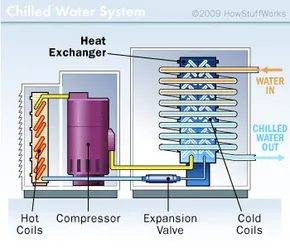
Imagine the entire air conditioning unit living on the roof or tucked behind the building. That is the core concept of a chilled water system. This central plant chills water to a precise range of 40 to 45 degrees Fahrenheit (4.4 to 7.2 degrees Celsius).
Once chilled, this cold water travels through insulated pipes to various air handlers throughout the structure. These handlers act like the evaporator coils in your home split system, but scaled up. The water circulates, absorbing heat from the air inside. If the pipes are well-insulated, distance becomes irrelevant. You can run these lines for long stretches without losing significant cooling capacity.
It is versatile. It works like a massive, building-wide refrigeration loop.
Cooling Tower Technology
Traditional AC units use air to dissipate heat from the compressor coils. Large commercial setups often replace that air-cooled approach with a cooling tower.
Here is how it functions. The tower creates a stream of cold water that flows through a heat exchanger. This water cools the hot condenser coils of the main chiller. The tower blows air through a spray of water. Some of that water evaporates. The phase change from liquid to gas pulls heat away from the remaining water, cooling the stream significantly.
This method is not without drawbacks. You must regularly add water to the system to replace what is lost to evaporation. The actual cooling power also depends heavily on external factors. High humidity and low barometric pressure can reduce efficiency.
Off-Peak and Ice Cooling
Rising electricity costs and environmental concerns have pushed developers to explore alternative cooling methods. One emerging option is off-peak or ice-cooling technology.
This system works differently than standard AC. It freezes water into ice during the evening hours. Why at night? Community demand for power is at its lowest. Energy rates are cheaper. The ice is stored in tanks. During the hottest part of the day, the system uses the melting ice to chill interior air.
The energy draw is real. But the biggest drain happens when the grid is least stressed. This lowers peak demand on the power infrastructure. It saves money. It eases strain on the grid.
Geo-Thermal Heating and Cooling
Another option gaining traction is geo-thermal heating. The temperature of the earth remains fairly constant at a depth of around 6 feet (1.8 meters). It ranges from 45 to 75 degrees Fahrenheit (7.2 to 23.8 degrees Celsius) year-round.
Geo-thermal cooling uses this stable ground temperature as a heat sink or source. Instead of generating cold with electricity, you move existing heat. The most common residential type is a closed-loop system.
Polyethylene pipes are buried underground. A liquid mixture fills these pipes. In winter, the fluid absorbs heat from the earth. It carries that warmth into the building. In summer, the system reverses. It pulls heat from your home and deposits it underground. The ground absorbs the excess heat.
Solar Powered Air Conditioners
For those seeking genuine energy efficiency, solar powered air conditioners are entering the market. The technology is still refining. There are kinks to work out.
Yet the market potential is clear. Around 5 percent of all electricity consumed in the U.S. goes toward powering air conditioning. That is a massive chunk of energy use. Developers are responding. They are building units that rely on sunlight rather than the grid.
The shift isn’t just about saving money. It’s about reducing the footprint of cooling a building. Chilled water systems handle the scale. Cooling towers manage the heat rejection. Off-peak storage smooths the demand curve. Geo-thermal taps into the earth. Solar taps into the sky. Each method offers a different path to lower energy bills.
Which system fits your specific climate? Which offers the best return on investment for your budget? The answers depend on your location, your building’s age, and how much you value upfront cost versus long-term savings.
The technology exists. The infrastructure is there. The question is whether you are willing to change how your home handles the heat.


